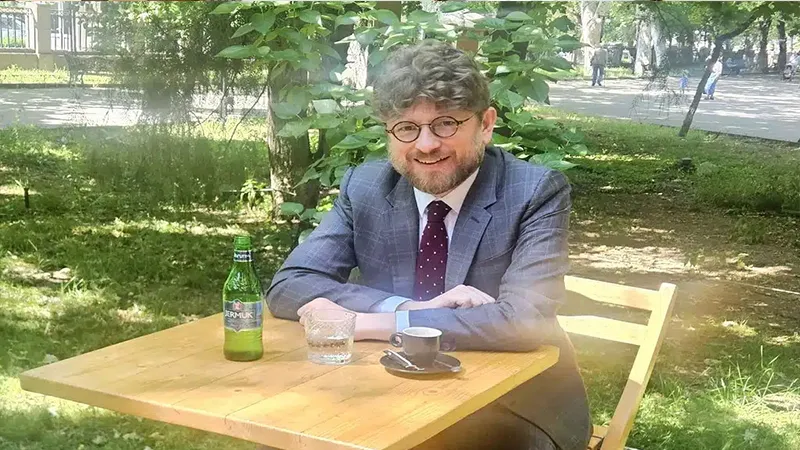
1in.am The French ambassador Olivier Decottignies, who has completed his mission in Armenia, summarized his three years in an interview with Nouvelles d’Arménie Magazine with a statement that says much more than a typical diplomatic assessment. According to him, France has a clear line towards Armenia: «comprehensive, unconditional, and consistent support». The relationship, built on historical friendship, has now become strategic, but Decottignies' farewell interview is more interesting as a testimony to Armenia's geopolitical transformation in recent years from the perspective of a European diplomat who has closely followed the developments.
He arrived in Yerevan in 2023, at a time when the Armenian population of Artsakh was being displaced and the old security system of Armenia was collapsing. He is leaving a country that is trying to build its security and foreign policy on a new principle—creating a multilayered system of partnerships instead of dependence on Moscow, which expands Armenia's strategic independence and freedom of choice.
The ambassador's most precise formulation on this matter is: Armenia has realized that its allies are not always its friends, and friends are not always allies. In 2021-22, when the danger was already concerning Armenia's internationally recognized territory, the Russian security system failed to function.
The defensive perception built over one hundred fifty years collapsed at the country's real border.
What is crucial for Armenia here is not to transition from one dependency to another. The lesson from the collapse of the Russian foothold is not to seek a new patron but to build a security system where no external force becomes irreplaceable for Armenia.
The new quality of relations with France is important precisely in this context. Paris became the first NATO capital to open access to Western modern defense systems for Armenia, a member of the CSTO. A French defense mission was established in Yerevan, followed by infrastructural programs, investment ties, and support for Armenia's rapprochement with Europe. Thus, historical friendship is gradually acquiring an institutional basis for a strategic relationship.
However, the meaning of rapprochement with France is not to replace Russia with a new patron. Today, Armenia is simultaneously deepening its relations with Europe, the United States, India, China, the Gulf countries, and Iran. This is not merely an expansion of external ties; Armenia is attempting to replace the security model dependent on a single center with a system of complementary partnerships, thereby increasing its own strategic independence.
The same dependency must also be overcome by Armenia in the economy.
For decades, the Russian market has been not only one of the main export directions for Armenia but also a tool of political influence. When market access can be restricted due to Yerevan's foreign policy choices, economic dependency turns into political vulnerability. According to Decottignies, this is where Russia becomes an unreliable trading partner: market access turns into a tool of political pressure. Europe's response was based on the opposite logic—expanding access to the European market for Armenian goods in response to Russian restrictions.
The difference is not only in the geography of the market; the issue is whether the economic connection creates dependency or a protected opportunity under rules. In one case, the door to the market can be closed for political disobedience; in the other, it remains open as long as clear and uniform rules are maintained for everyone.
However, Europe is by no means an easier partner. The European market demands quality and competitiveness, while the European political system requires the rule of law, freedoms, and strong institutions. It is no coincidence that when discussing Armenia's rapprochement with Europe, Decottignies simultaneously warns about the deterioration of press freedom indicators.
This is the difference between patronage and integration.
A patron demands loyalty. A system requires compliance with the rules.
Armenia's new foreign policy should be built precisely on this logic—different defense partners, different markets, different economic ties, and as few irreplaceable dependencies as possible.
Decottignies also states a simple but important thing in the interview: Armenia is a small country, but it is not a child. It can make decisions and define its own interests. The strength of a small state is not to resemble a great power. Its strength lies in not losing the opportunity to choose. Therefore, France's greatest service to Armenia will not be if it becomes its new patron. The Franco-Armenian strategic relationship will achieve its true purpose if it helps Armenia become a state that no longer needs a patron.
Decottignies departs, reminding that the strength of a great power is also its reliability—the ability to keep promises.
For Armenia, the opposite side of that thought is more important. Sovereignty begins where the loss of any friend no longer means the loss of the state's security, economy, or future.
* This text was automatically translated by Artificial Intelligence (AI).


 ENGLISH