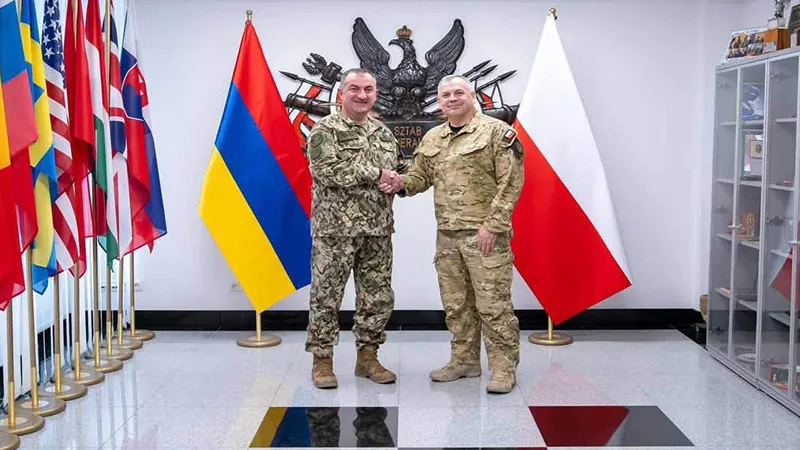
1in.am The meeting of the Chief of the General Staff of the RA Armed Forces, Edward Asryan, with his Polish counterpart Wiesław Kukula may seem at first glance like another episode in the agenda of military diplomacy. However, amid the developments of recent months, it already holds a different significance: the defense relations between Armenia and Poland are gradually transitioning from a phase of meetings to systematic cooperation. In February, Armenia and Poland signed a new agreement on military-technical cooperation, in May the defense ministers discussed military education, cooperation between military universities, and the establishment of an office for the Armenian military attaché in Warsaw, and now the relationship has reached the level of the general staffs of the two armies.
The need for cooperation with Poland no longer requires justification today. More importantly, it is essential to understand why this long-unrealized potential is beginning to transform into a real political and defense partnership right now. For three decades, there have been attempts at political, economic, and military-technical cooperation between Armenia and Poland. A government commission for military-technical cooperation was established back in 2012, and an economic cooperation commission in 2019. However, the potential of the relationship has consistently been greater than the results. This was also noted by Polish President Andrzej Duda in 2024 in Yerevan, stating that during his 9.5 years in office, bilateral relations had not reached this level before.
It is after Duda's visit in November 2024 that the picture begins to change. The Polish president openly supported Armenia's rapprochement with the European Union in Yerevan, and after that, political contacts began to transform into concrete institutional steps. This rapprochement essentially continues the path that was left unfinished more than a decade ago. In 2013, Poland was one of the most active supporters of Armenia's European association. Warsaw, along with Sweden, was a initiator of the Eastern Partnership and viewed Armenia as one of the countries that could deepen political and economic integration with Europe. The negotiations on Armenia's association with the EU and the Deep and Comprehensive Free Trade Agreement were completed in the summer of 2013. However, on September 3, Yerevan announced its decision to join the Customs Union, and the planned initial signing in Vilnius did not take place.
Thirteen years later, Armenia and Poland meet in a completely different Europe and a completely different Poland.
In 1989, Poland emerged from the Soviet bloc with a relatively modest income per capita, an army built according to Soviet standards, and the legacy of the Warsaw Pact. In 1999, it became a member of NATO, and in 2004, of the European Union. Today, Poland is one of the major economies in Europe and one of the continent's fastest rearming military forces.
In 2026, Warsaw plans to spend around 200 billion zlotys on defense, about 4.8 percent of its GDP. This is more than double the minimum threshold required by NATO. The Polish army already has over 210,000 servicemen, and the state's goal is to create armed forces of 300,000. The territorial defense forces are already exceeding 41,000.
However, Poland's value for Armenia is not just the size of its army; Warsaw is currently implementing one of the most extensive military modernizations in Europe. The Polish army simultaneously operates or acquires American Abrams and South Korean K2 tanks, Polish Krab and Korean K9 self-propelled artillery systems, F-35 and FA-50 fighter jets, and Apache helicopters. A multi-layered air and missile defense system is being built with Patriot/IBCS, Wisła, and Narew systems, meaning Poland is a unique military laboratory; it has learned to combine weapons from different manufacturers into one army.
This is an extremely valuable experience for Armenia. Today, the Armenian army already features systems from Russian, Indian, French, and Armenian production side by side. The next challenge of diversification is no longer just purchasing new weapons. It is necessary to make these different systems into one functioning army with common communication, management, logistics, training, maintenance, and standards. Poland is implementing that transition on a much larger scale.
Here opens the real field of cooperation—from officer education and exercises to communication systems, defense industry, ammunition, technical maintenance, personal equipment, and compliance with NATO standards. The February agreement already provides for the exchange of information regarding the weapons used, scientific research cooperation, and the development of ties between the defense companies of the two countries.
This also means a market. Poland is not only a state that buys weapons but also a country with a rapidly developing defense industry and a huge market for European rearmament. Under the EU SAFE program, Poland alone has access to up to 43.7 billion euros in preferential financing for defense purchases. For Armenia, the question here should not only be about buying Polish products; it should consider joint production, subcontracting, involving Armenian technology companies, and entering Polish and European supply chains.
However, Poland's most significant advantage is not even military; it is political experience.
Poland is a key state that was part of the former socialist bloc, which managed to use its membership in NATO and the EU to multiply the capabilities of the state. Warsaw knows the Soviet system from the inside and the Western system through its own transformation experience. It understands what it means to change military standards without dismantling the army, to open the economy without losing the state, and to make European integration a tool for modernization.
For Armenia, this may be a more useful experience than the example of Western European countries. France has never been a member of the Warsaw Pact. Poland has been.
Poland also has a practical understanding of Russia. Its historical memory, geography, and the war in Ukraine have made security issues the center of state policy. That is why Warsaw is today one of the key states on NATO's eastern flank.
This, of course, does not mean that Armenia should repeat the path taken by Poland. Armenia is not Poland; its geography is different, its security environment is different, and there is no prospect of NATO membership today. But Armenia can take the most important lesson from the Polish experience: to build security not on the irreplaceability of one external anchor but on its own defense capability, strong state institutions, and a diversity of partnerships.
It is in this context that the Asryan-Kukula meeting gains its real significance. Armenia does not need Poland as a new security patron. It is valuable as a partner that has already gone through a state and military transformation path, at the end of which Armenia is now standing—ranging from army modernization and defense industry to the implementation of European standards and political and economic integration.
In 2013, Warsaw was one of the supporters of Armenia's European path, but that path was closed on September 3. In 2026, the same relationship returns in a more practical form—with contracts, military education, defense industry, and connections between the general staffs.
Thirteen years ago, Poland was helping Armenia get closer to Europe. Today, it can help Armenia learn how to live, defend itself, and develop within the European system.
* This text was automatically translated by Artificial Intelligence (AI).


 ENGLISH