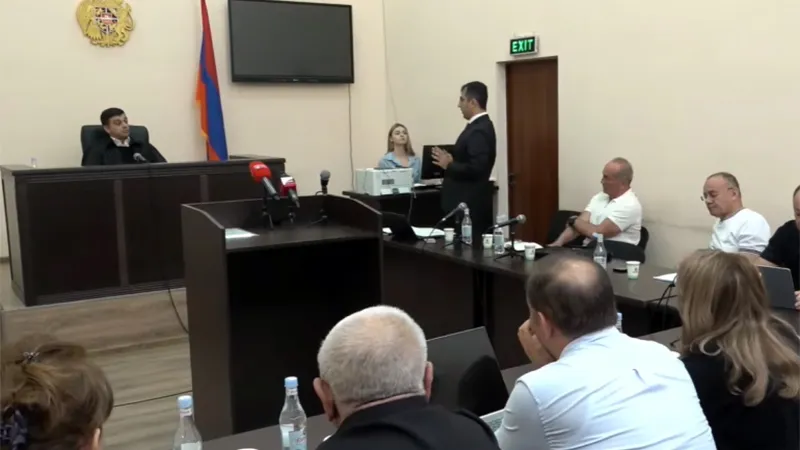
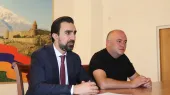
tert.am. Regardless of how it is phrased, holding a meeting with the armed forces and presumably giving instructions falls within the president's powers. This was stated by lawyer Aram Orbelyan during a court session, commenting on the charges attributed to the second president of Armenia, Robert Kocharyan:
According to the prosecutor, Robert Kocharyan illegally established the procedure for involving the armed forces with his decree and used the army in internal political processes. It is noted that crossing the boundaries of the president's official powers has grossly violated citizens' constitutional rights to hold peaceful gatherings.
««Evaluating that action as lawful or unlawful, clearly exceeding the scope of his powers» is the very first example that this cannot be assessed out of context, nor in context, when we talk about exceeding powers. Theoretically, if we accept that this is correct, although the evidence shows that it is wrong, it cannot be put to assessment. Article 49 of the Constitution establishes legislative guidelines for interpreting the content of the president's powers; the interpretation article itself is sufficient constitutional grounds for the president to carry out various authoritative actions as the head of state without additional powers,» Orbelyan noted:
Orbelyan emphasizes that within the framework of the function of upholding the Constitution, the president can take steps to ensure that the armed forces maintain neutrality in political matters.
«The president has constitutional powers to coordinate the activities of all state bodies in the field of defense, to make decisions regarding the use of the armed forces, ensuring the Republic of Armenia's consent. They place on the Republic's territory the guarantee of such a vital value for the country as national security; entrusting the president with such a problem was largely conditioned by the fact of his direct election by the people. By the way, after the changes in 2015, these powers were removed from the Government and are essentially now under parliamentary control.»
It turns out that the president at least had the authority to act based on his status; the question is what other means of implementation there were, while regarding the inclusion of means, the president acts with immunity.
From the general lines of the accusation, it becomes clear that the president is accused of clearly exceeding his powers, while the aforementioned interpretation directly indicates that he acted within his powers and role; in other words, the president had the authority to exhibit such behavior, which is an undeniable fact,» Orbelyan emphasized:
Let us remind you that the case concerns determining legal responsibility for the events of March 1, 2008.
* This text was automatically translated by Artificial Intelligence (AI).


 ENGLISH